Focus

Mar. 5th, 2019 11:22 am
emptymanuscript: Preschool Handwriting Paper with three lines visible. In cursive script on the top line are the words "One Upon a Time" while on the bottom line are the words, "The Hero Dies." In block script, on the middle line, it reads, "The Empty Manuscript." (Default)
Let’s talk about focus.

I’ve met a fair number of people in my time who are just trying to do too much. They’re working on an idea that they want to be a book and a movie and who knows what else because it is so amazing. And all they want is just a little help with this magnificent idea they have from other people who get it.

There is some variance in this. While there is the obnoxious easily recognizable neophyte whose definition of “get it” is amazement at its perfection plus some tiny idea they can steal as their own to make it pop even more. There is also the person who exudes a bit more experience, really does want to work, but still doesn’t understand that getting and doing everything isn’t the way it works.

An idea is not the same as a story. A story is not the same as a book. A book is not the same as a script. A script is not the same as a movie deal. These and so many other steps in the process are individual endeavors. And if you try to do them all at once, none of them will turn out any good.

To borrow from what I hope is relatively common experience, it’s like studying for the SATs. While your final score is given to you as a lump sum, when you’re getting ready for it, you don’t study in a lump, going randomly back and forth between problems of different types. I remember when I was in Kaplan, which at the time was the biggest study prep institution, there were actually separate classes for the Math and English portions. Most of us had signed up for both, one right after the other, but you had one hour devoted to each and only that particular one.

This is the same thing. You work on one thing at a time because a large portion of the execution is fundamentally different. If you try to do an English problem like a Math problem you’re probably going to mess up. And it’s going to be worse if you try to do a Math problem like an English problem.

So let’s start with your about. It’s about an X who Y’s. It’s about a teenager who has cancer. It’s about an underfunded gentlewoman who needs a wealthy husband. It’s about an alien who tries to blend in as a human. Do you want it to be a book or a movie?

Why does it matter? Because your development approach is nearly exactly opposite. The cliché is, “The Same BUT Different.” You need both.

But film development emphasizes the first, sameness, because it’s fundamental goal is reaching as large an audience as possible. Breadth is what makes producers the most money. If a thousand people see it and say, “eh,” that makes more profit than if a hundred people see it and adore it for the rest of their lives. This is because of how Hollywood has arranged its business model. They get the most money per movie in the first two weeks. As time progresses, the studio gets a smaller percentage of the profit. So what they’re looking for is something that can appeal to the greatest number of people with the least amount of effort in a great initial push. That means complexity and depth are low concerns. If a fan says to a friend two years later, “This movie changed my life, you should watch it,” it’s too late.

Book development emphasizes the second, difference, because it’s fundamental goal is reaching an eternal audience. Yes, large initial sales are important, but if that same fan says to another friend twenty years later, “This book changed my life, you should read it,” relatively close to the same amount of money goes into the publisher’s coffers. They want breadth but they’re really looking for depth. They want something unique so the reading public has to get this book because they can’t get that experience anywhere else. The profit motive is based on the long haul not the short term. This is the real reason that ebooks are taking over. Because it means that perennial best sellers can be kept eternally in stock at almost no cost but people are buying them in the same numbers, leading to greater profits.

So you’ve got your starter idea. It’s about a teenage alien that tries to blend in with humans as they die from space cancer. How do you want to develop it? Do you want a movie? Do you want a book? If it’s a movie, then you’re trying to hit all the standard emotional tropes of this idea. You want someone to look at that idea and know 100% what they’re going to get. If it’s a book, then you’re trying to twist it into something unexpected yet inevitable, the reader should be pleasantly surprised by what they’re going to get. These are not compatible goals.

Ok, you really REALLY want both. You pick one to start. Hollywood and New York do have a symbiotic relationship. Movies that Hollywood thinks are going to be blockbusters do get book tie ins. There is, unfortunately, a decent chance you will not be asked to write the book version of your movie. It goes the other way, too. New York sells Hollywood its best successes to be made into movies. There is, unfortunately, a near certainty that you will not be asked to write the movie version of your book. There are exceptions, it does happen, but they are rare. One of the things to remember in these situations is that you are playing the numbers. And while you do have to be a little deluded just to move forward, it is worth keeping in mind that there is diminishing chance of returns for ever greater effort. Only about 2% of books are profitable. Only about that same percentage of profitable books get picked up for movies. Only about that same percentage of arrangements has the same writer for both projects. So, to give the benefit of the doubt, that’s somewhere on the order of a thousandth of a percent chance. It’s not zero. But it’s not a good business model.

So, pick the one that’s more important to you. If you really want to write a book, write a book and play the much better odds that you can get someone else to make it into a movie. If you really want to make a movie, write a script and play the much better odds that you can get someone else to make it into a book. If you’re very lucky, that someone else will also be you but you have to have that fist element first. And whichever one you pick is going to be years of work. So pick right and concentrate. The other choice is going to be a distraction.
emptymanuscript: Preschool Handwriting Paper with three lines visible. In cursive script on the top line are the words "One Upon a Time" while on the bottom line are the words, "The Hero Dies." In block script, on the middle line, it reads, "The Empty Manuscript." (Default)
So I’m binge-reading self help books at the moment. And right now I’m on Fear Less by Dean Sluyter. And I’ve gotten to a bit where he is recounting an evening when he was running meditation workshops for prisoners. The story revolves around the identification of “That Guy.” Your life would work out if it wasn’t for “That Guy.” It gets fairly easily and amiably to the realization that the absence of “That Guy” won’t make your life better, there will just be someone else who will then become “That Guy.”

But then the book goes farther. Rather than stopping at “That Guy” not being the problem, Sluyter brings up the Dalai Lama and Gurus. Who does the Dalai Lama identify as his guru? The teacher that brought him to his level of enlightenment? Mao Zedong. The man who ordered the invasion, mass murder, and exile that destroyed the Dalai Lama’s original way of life in Tibet. The ultimate “That Guy.” Sluyter even upgrades him to the term Nemesis, the destroyer. His Nemesis was his ultimate teacher.

Which is when my training kicks in and I start nodding. Because this is the Hero’s Journey. It’s the protagonist’s Nemesis, the antagonist, who teaches them what it means to be the best them. It’s the conflict between the Thesis of the protagonist and the AntiThesis of the antagonist that produces the new Synthesis of a “better” world. At least for one of them. And in one view, an alternate around the idea of 4 act structure, there is even the idea of enlightenment’s stepping back from thought and old action: Thesis, Antithesis, Nothingness (Which I can’t for the life of me remember the word for or the book it comes from), and finally Synthesis. The importance there is not just incorporating the lessons of the Antagonist but also using them to undo the Protagonist’s own flaws brought into the system and exposed by the Antagonist.

So it’s worth asking: How is your Antagonist your teacher?
emptymanuscript: Preschool Handwriting Paper with three lines visible. In cursive script on the top line are the words "One Upon a Time" while on the bottom line are the words, "The Hero Dies." In block script, on the middle line, it reads, "The Empty Manuscript." (Default)
It's funny. The way the Joker is funny. My partner and I had a talk about my work this last weekend. More specifically my work output. And how it wasn't cutting it.

We agreed that it would be much better for me to sacrifice some quality in order to go faster. I'm not exactly writing high art. I'm really not writing to have it completely done in this coming draft. So I can fix whatever is wrong. And just, it needs to be done. I'm late. So very late. This book should have been DONE in 2016, instead of me worrying I won't finish in 2019.

And here I am, not working.

The fundamental problem with this book is that it feels so very far beyond my skill. Which was the other thing we talked about: dumb it the f#@% down. I'm not writing the literary equivalent of a rubik's cube either. My book is supposed to be closer to a romp than a riddle. It just needs to... I don't know... communicate the right things which are hard.

Every time I try to nail down what it is that I'm trying to say it feels off. Is it a buddy story? Yeah, totally, because the real spine of the plot are my main characters becoming friends. But is that what the adventure is? No, not really. It's a whydunnit. Because that's the revelations I want to work with, the uncovering of my main character's soul and sins - which is why he is such a misanthropic SOB. But that's theme more than plot. So what's the plot? An evil witch trying to sacrifice children to an elder god while my characters try to stop her. And I don't know... the connection feels loose, like a jiggly plug. So the power keeps going out of the story.

Like it all connects.

James wants to fight Helgapel because he wants to redeem himself from his past mess ups. Helgapel's main weapon is using ghosts and memories to drag James' past mess ups out so Zephyr can witness them. James tries to keep Zephyr at arm's distance because he wants to hide his past. Zephyr accepts James as he is, so they're able to cooperate and throw off Helgapel's magic.

There's just... it doesn't... I dunno... groove, man. I see it but I don't grok it. And I don't know how to fix that.

It's one of those things where if I went back in time to 2014, I'd probably tell myself to make fundamentally different choices. Which makes me wonder if that's what I need to do. Which would mean I've wasted the last three years.
emptymanuscript: Preschool Handwriting Paper with three lines visible. In cursive script on the top line are the words "One Upon a Time" while on the bottom line are the words, "The Hero Dies." In block script, on the middle line, it reads, "The Empty Manuscript." (Default)

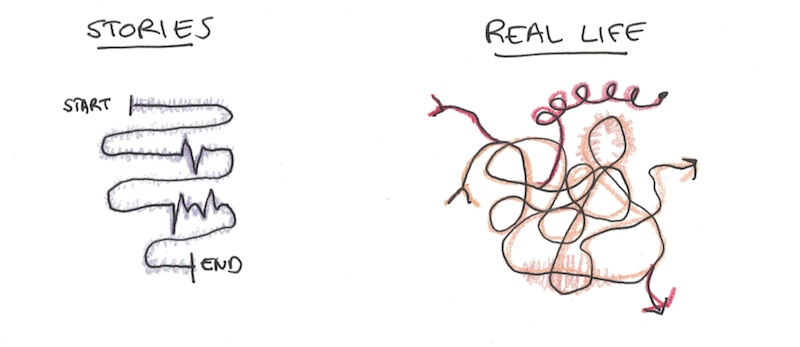
This is from the article Twenty-Five Useful Thinking Tools. Which is a pretty cool article. But this in particular strikes me as a fantastic illustration of how the art of story works. Even with nonfiction, we pare and organize into straight emotionally logical paths. What allows our creativity to thrive are the forms we have to stick to in order to make it FEEL real rather than to report reality as the chaotic mess it is.
emptymanuscript: Preschool Handwriting Paper with three lines visible. In cursive script on the top line are the words "One Upon a Time" while on the bottom line are the words, "The Hero Dies." In block script, on the middle line, it reads, "The Empty Manuscript." (Default)
Well, I finally have an AO3 account.

:/ now I have to decide how to use it :/

Like, do I really want to post up all my fics? My one Star Wars fic is safe enough. But after that I get into the stuff that I'm not really sure I want associated with me. Might be worrying over nothing though, after all the problem is never having too many readers. I just know some of my stuff is "divisive" to be kind.
emptymanuscript: Preschool Handwriting Paper with three lines visible. In cursive script on the top line are the words "One Upon a Time" while on the bottom line are the words, "The Hero Dies." In block script, on the middle line, it reads, "The Empty Manuscript." (Default)
Cui Bono is a phrase mostly attributed to Lucius Cassius Longinus Ravilla, who gained fame as a judge in the Roman republic before eventually rising as high as being Consul in 127 bce. When asked how he became such a great judge he said he got in the habit of always asking, Cui Bono, 'to whom is it a benefit.' An easier translation is, 'who benefits?' which is how I learned it. And it's one of those things that I've found continually useful in my life.

Cui Bono? I received an email today asking me why I hadn't submitted The Hidden and the Maiden to the Book Excellence Awards‬‬‬‬‬‬‬‬‬. Said email was from the Book Excellence Awards‬‬‬‬‬‬‬‬‬. Who I haven't had previous contact with. Now on the surface, of course, I could benefit. :D !!! Just submit my work and maybe I could win an award or few. Increase sales! Gain exposure! Cui Bono. If this is a real award, why would they need to pursue entrants. We're always looking for ways to increase sales and exposure and clout and claptrap. If you have something worth getting, authors will flock to you like flies. But of course, we can't forget that there is the entry fee. Lots of entry fees. Enough entry fee money that they can afford to pay some poor sad sap to trawl through the internet looking for other poor sad saps who just want someone to read the work they poured years of their life into.

I'm also talking to a book reviewer right now. She's very upfront. She told me why she contacted me. She gave a clear range of her pricing. She made no illusions that she wasn't a business and was clear on her business practices. And you know what, I can work with that. You want to be in business with me for a week or two, cool, let's do business.

It's a very different thing. The reviewer was up front with how she benefitted from me. She was upfront with how she couldn't guaruntee my benefit but that she had all these tools to benefit me if I took up her service. This award is just an award. It does... well I'm really not sure. It portrayed only the ephemeral benefits. That I had a chance at getting. That's the mark of a scam. When only one side will benefit, they don't want to tell you how they're benefitting off of you. A business will show how you both pay and both benefit. Legitimate people will tell you how they benefit because they don't have to hide it. They won't make you guess. Cui Bono?

So next time someone comes to you with a great deal, remember to ask the question. It'll save you lots in the long run.
emptymanuscript: Preschool Handwriting Paper with three lines visible. In cursive script on the top line are the words "One Upon a Time" while on the bottom line are the words, "The Hero Dies." In block script, on the middle line, it reads, "The Empty Manuscript." (Default)
Bleh. I just don't want to do anything today. I am in a pop-o-funk. It's tiny and widji like a funk-o-pop doll crossing it's arms and holding its breath in a pathetic little temper tantrum until it turns colors.

Like, there's nothing wrong. I got up at a somewhat reasonable hour. I went to my meeting today. I had lunch. My ankle which may or may not be tendonitis feels better. And still. :/ So it may be my med decrease. Which I really don't want it to be. Because that means I'll have to go back up instead of tapering down and there's just no end in sight.

I would probably feel better if I just got in some writing. It makes me feel better. I just have to type a few words. Just just just. Even a sentence. I'll feel better if I write a sentence. Or make a correction. Or something. I don't know.

I am having too many of these days. I should have been done with this book in 2016. 2017 at the latest. And it is 2019 now. And my immediate thought is that I'm not going to get it done this year. I can't spend this long writing books. Books can't take 6 years to write. There are romance authors who knock two out a month. Every month. And this is year 4 for me. I can't afford to not want to do anything.

And isn't depression supposed to be temporary? like a few months maybe. I just can't afford to keep being depressed forever either. I am spending so much money in health bills. And I'm really just complaining at this point. Sorry. That was definitely a benefit of tumblr, I had my main blog and my vent blog, which nobody read, so it kind of didn't matter what I said.

So, enough venting. I'm going to go write something. And I'm going to feel better because I wrote something. And so there.
emptymanuscript: Preschool Handwriting Paper with three lines visible. In cursive script on the top line are the words "One Upon a Time" while on the bottom line are the words, "The Hero Dies." In block script, on the middle line, it reads, "The Empty Manuscript." (Default)
It’s very simple: in order to write stories like the ones that move you, you need to look at the stories that affect you and figure out what those authors and filmmakers are doing to get the effect they do. So you are going to be making a lot of lists: lists of your favorite movies, lists of your favorite hero/ines, lists of your favorite endings, lists of the most suspenseful stories you have ever seen or read.

Sokoloff, Alexandra. Story Structure Basics: How to write better books by learning from the movies (Screenwriting Tricks For Authors (and Screenwriters!) Book 1) (Kindle Locations 184-187). Kindle Edition.
emptymanuscript: Preschool Handwriting Paper with three lines visible. In cursive script on the top line are the words "One Upon a Time" while on the bottom line are the words, "The Hero Dies." In block script, on the middle line, it reads, "The Empty Manuscript." (Default)
my friend’s friend is my friend
my friend’s enemy is my enemy
my enemy’s friend is my enemy
my enemy’s enemy is my friend

Heider’s Balance Theory (1958)


While Social Balance Theory is somewhat outmoded, it's still used plenty in advertising and therefore storytelling. In Social Balance Theory the triangles are POX triangles. Person. Other. X, as in an equation. The idea is fairly simple. You are the person and you're taking in this story. The other is the point of view character: the celebrity, cool spokesperson, etc. that you can trust, like, or identify with. X is the product. Because you like the pov character and they like the product, you are more likely to like the product.

You can extend this to any conformation. If you dislike the fact that we're in the middle east. But you hate President Trump and he comes out and says we should leave. You're likely to feel more positive about us being militarily in the middle east than you did. Because the enemy (disliked X) of my enemy (the hated other) is my friend.

Most important for me, though, is that this is a tool in larger scale fiction. Person P is the reader and I want them to feel certain ways when they're reading my text. So I can set up POX triangles to help sell those feelings. I want the reader to like a character, so I set the character up positively with something I can reasonably expect the reader to like. This is a major part of the principle behind "Save the Cat!" I can also set them up negatively against something I can reasonably expect the reader to dislike - because two negatives net a positive as in the enemy of my enemy is my friend.

On the other side, let's suppose I've gotten my character likable. Once I am safe relying on any reader (P) who is still reading liking my character (O) then I can sell goals (X) off my character. Because Character O wants and feels positively about an element (X), the reader (P) is more likely to feel positively about it, too.

As Social Balance Theory has become more sophisticated - people are still writing papers on it - one of the things that it has delved deeper into is the idea that things aren't an easy positive or negative but that there are varying degrees. Such as maybe feeling -2 about vanilla icecream but +5 about Tom Hiddleston, so even if Tom Hiddleston came out and said he LOVED vanilla icecream, you wouldn't start disliking Tom Hiddleston and you wouldn't start liking vanilla icecream but you might become more tolerant of other people liking vanilla in the abstract.

This too can be used for our fiction. You can play a numbers game with how you want people to feel. This is what I'm nearly always trying to do with my character, JJ. I need her to be a monster but I also want everyone to like her. So what I can do is constantly switch my X's. I can make her son who loves her an X and show a moment of why he loves her. I can also make her an unholy terror against him but with it also showing why she might be doing it for his benefit. Then I can have her "save a cat." Then I can have her do something utterly horrible. And the play of switchoffs will hopefully make the reader have complex feelings about her. I always know I've succeeded when someone reluctantly admits they might like her in spite of how terrible she is.

This is also why you tend to want two "people" on the page at a time. With two and more you can play the emotions of the reader off of O and X in comparison to each other instead of just working with a single person on the page without comparison. Without comparison you are leaving it to the reader to decide purely on their own how they feel about things.
emptymanuscript: Preschool Handwriting Paper with three lines visible. In cursive script on the top line are the words "One Upon a Time" while on the bottom line are the words, "The Hero Dies." In block script, on the middle line, it reads, "The Empty Manuscript." (Default)
So, for those who don't know me, I'm something of a devotee of Orson Scott Card's writing advice. Whatever you think of his politics (and I've had to grit my teeth two feet from him so don't talk to me about it), he knows his stuff about writing. One of his best pieces of advice are three observations that cover about 90% of writing critique.

I don't understand what is written here.

I don't believe what is written here.

I don't care about what is written here.


You can phrase them any way you want. He actually termed them, "Huh?" "Oh, yeah," and "So what." I tend to say about five sentences when one would do. That's personal style. But the three basic observations will handle most problems. Pretty much all small scale problems and a suprising number of large scale problems.

As an example, what I'm working on now is a series of rewrites based around a scene that reveals a criminal secret as part of a character's past. I need his past to come out, that's kind of the central conflict of the book. But my wife, an exceptionally good content editor, just kept shaking her head. It wasn't working for her. And finally she just went with the basic, "I don't buy it. He's spent nearly twenty years covering this stuff up and it takes one page of dialogue for him to give it up. No. What you've set up, leads me to believe he would never tell." Which gives me, as the writer, everything I need to work out what I need to change.

Part of the duty of the writer is to interpret critique. To take the huhs and nahs and figure out how to apply (or not apply!) them to your story. With her identification of exactly what she doesn't believe: that my main character would not reveal a crime he spent a lifetime covering up, I can interpret that to change, ok, don't have HIM reveal it. I have other ways to reveal this crime. I can also change his reasoning for why he does the things he does, instead of trying to reveal, he can give information that is designed to cover up instead. And then it can backfire or whatever. It just has to be clear from him that he is trying to stymie the investigation rather than aid it.

And honestly, I'm not kidding, that's about it. 90% of the problems I have and the problems I see in the writing of others fall into one of those three categories. So, if you are ever at a loss for what to say or look for in a piece you're editing - or what to ask beta readers for - try the three critiques.

Profile

emptymanuscript: Preschool Handwriting Paper with three lines visible. In cursive script on the top line are the words "One Upon a Time" while on the bottom line are the words, "The Hero Dies." In block script, on the middle line, it reads, "The Empty Manuscript." (Default)
Eben Mishkin

March 2019

S M T W T F S
      12
34 56 789
10 11121314 1516
1718192021 2223
24252627282930
31      

Syndicate

RSS Atom

Most Popular Tags

Style Credit

Expand Cut Tags

No cut tags
Page generated Mar. 22nd, 2026 09:40 pm
Powered by Dreamwidth Studios